
Keeping forklift training records organized can feel like an endless task, especially with strict Occupational Safety and Health Administration regulations shaping every step. For every warehouse manager across the United States and Canada, clear documentation is the backbone of compliance and worker safety. Understanding the difference between handwritten sign-in sheets and robust, retrievable digital archives can help protect your operation from costly violations. Discover the components of compliant forklift training recordkeeping standards that keep your facility prepared and your operators safer.
Table of Contents
- Defining Forklift Training Recordkeeping Standards
- Key OSHA And CSA Recordkeeping Requirements
- Digital Versus Paper Training Records Compared
- Roles And Responsibilities For Warehouse Managers
- Common Recordkeeping Mistakes To Avoid
Key Takeaways
| Point | Details |
|---|---|
| Compliance with OSHA Standards | Employers must maintain detailed forklift training records to demonstrate compliance with OSHA regulations, especially following workplace incidents. |
| Record Retention Requirements | Records must be kept for five years from the end of the year training occurred to ensure availability during inspections. |
| Effective Documentation | Training documentation should include essential details such as operator names, training dates, equipment types, and trainer credentials to avoid compliance pitfalls. |
| Shift to Digital Systems | Adopting digital recordkeeping enhances accessibility, security, and compliance while reducing the risk of lost or damaged records. |
Defining Forklift Training Recordkeeping Standards
Forklift training recordkeeping standards exist because the Occupational Safety and Health Administration (OSHA) needs a clear, verifiable trail that your operators have received proper training. Without documented standards, there’s no way to prove compliance when an inspector arrives or, more importantly, when an accident occurs and liability questions surface. These standards aren’t abstract bureaucracy—they’re the difference between walking away from an incident and facing serious penalties.
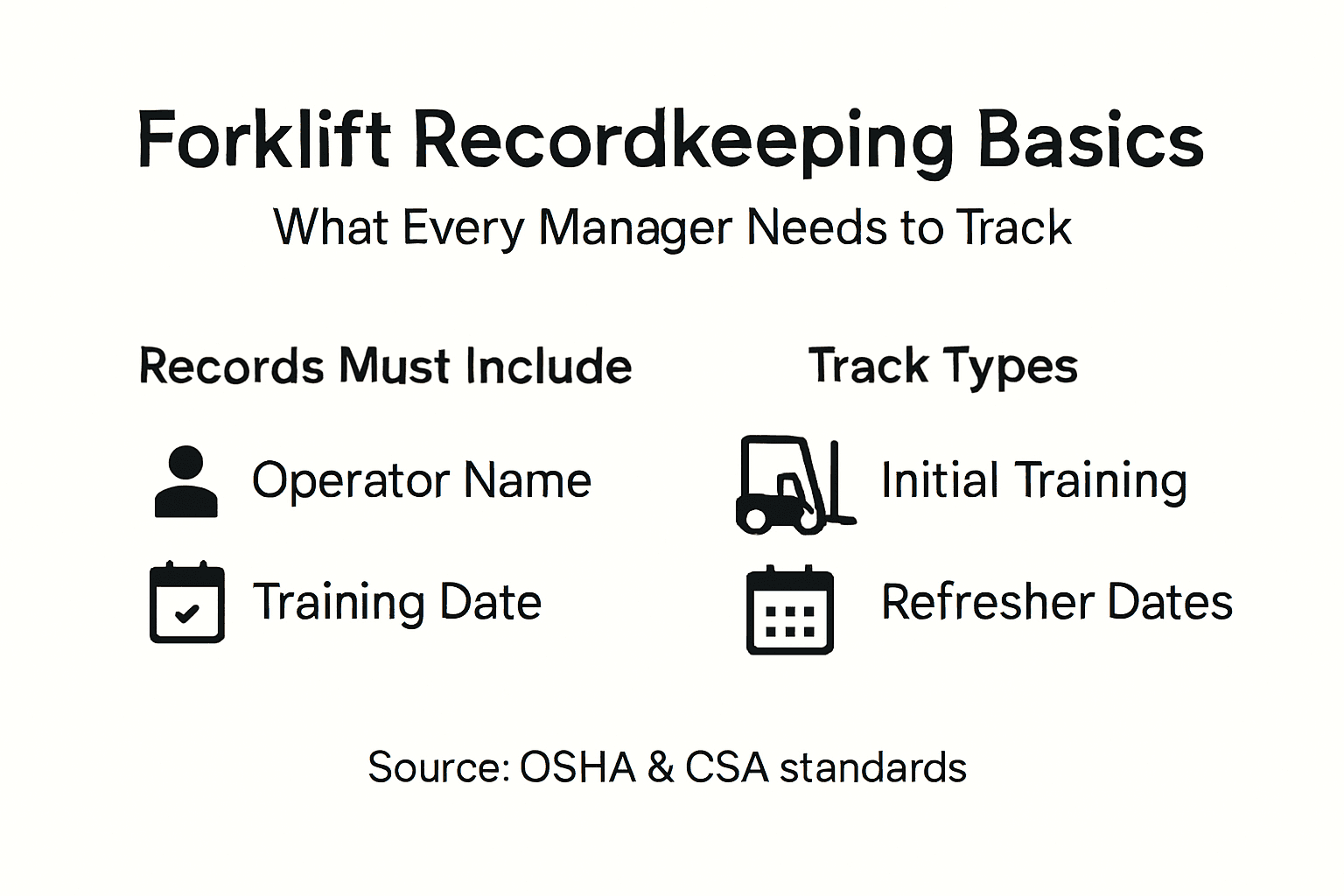
The core requirement comes down to this: OSHA recordkeeping regulations mandate that employers with 10 or more employees maintain detailed records of workplace injuries and illnesses, including those related to forklift operations. But forklift training documentation goes beyond just injury tracking. Your training records must include specific information about when the operator was trained, who conducted the training, what equipment was covered, and whether the training included both classroom instruction and hands-on evaluation. These elements form the foundation of what OSHA considers compliant recordkeeping. If your warehouse manager certifies someone on a Toyota 8FGCU without documenting the training date or the evaluator’s name, you’ve left yourself exposed. The standard requires that you capture the essentials: operator name, training date, type of equipment trained on, and trainer credentials.
OSHA uses a classification system to determine which employers must maintain these records. Certain low-hazard industries have exemptions, but most warehouse operations using forklifts fall under covered industries. The agency applies the North American Industry Classification System (NAICS) to identify exempt versus covered operations, meaning your facility almost certainly needs to comply. The recordkeeping standard specifies that you maintain records for five years from the end of the year in which the training occurred. This timeline matters because OSHA investigators often look back multiple years when investigating an incident. A warehouse manager who disposed of training records after three years could face additional violations during an inspection.
What makes standards practical for your operation is understanding the documentation components you actually need. Training records should include the trainee’s name and ID number, the training date, the type of forklift or powered industrial truck covered, proof of evaluation (typically certification cards), and the trainer or evaluator’s qualifications. Some warehouse managers think a handwritten note signed by a supervisor counts as recordkeeping. That’s understating the requirement. OSHA expects organized, retrievable documentation that shows a systematic approach to training and evaluation. Whether you use digital platforms like those offered through comprehensive compliance resources or maintain physical files, the standard demands that records be accessible for review by employees and OSHA representatives upon request.
Your recordkeeping also needs to distinguish between initial training and refresher training. An operator who completed certification in 2021 but received refresher training in 2024 should have records reflecting both events. This distinction becomes critical during accident investigations because regulators want to know exactly when someone last received instruction on safe operation. A trained operator involved in an incident three years after their last training is a different liability scenario than one trained within the past year.
Pro tip: Implement a digital recordkeeping system that automatically flags training expiration dates and refresher requirements—this prevents the common warehouse problem of operators continuing to work long past their training validity while keeping meticulous audit trails for inspections.
Key OSHA And CSA Recordkeeping Requirements
OSHA doesn’t just want you to train your operators. The agency wants documented proof that you trained them, what was covered, and who conducted the training. The Occupational Safety and Health Administration enforces the Injury and Illness Recordkeeping Rule through 29 CFR Part 1904, which sets out specific requirements for how long you keep records, what information must be included, and who has access to them. For forklift operations, this means your training documentation becomes part of your overall workplace safety recordkeeping obligation. If an operator gets injured on a forklift, OSHA investigators will immediately ask for training records. Not having them creates an immediate compliance violation before you’ve even addressed the incident itself.
Here’s what the federal standard actually requires. OSHA recordkeeping rules mandate that you maintain training records including sign-in sheets, course outlines, trainer qualifications, and certification documentation for a minimum of five years. This five-year retention period runs from the end of the calendar year in which the training occurred, not from the training date itself. A warehouse manager who trained someone on December 15, 2024 must keep that record through December 31, 2029. Many facilities mistakenly think they can purge records after three years or when an operator leaves the company. That’s a dangerous assumption. When OSHA shows up to investigate an incident from 2022, they want to see 2022 training records. Additionally, trainers must retain documentation that verifies training delivery even after they leave your organization. This means if your trainer moves to another warehouse, you need to maintain copies of that person’s credentials and the classes they taught. The trainer’s departure doesn’t absolve you of the recordkeeping requirement.
Canadian operations face similar but slightly different requirements through the Canadian Standards Association (CSA). While CSA standards follow comparable safety principles to OSHA, the enforcement mechanisms and specific documentation requirements vary by province. In Ontario and other provinces with provincial jurisdiction, compliance with provincial workplace health and safety legislation often references CSA standards for powered industrial trucks. The CSA B735 standard for powered industrial truck operation emphasizes trained and competent operators, meaning you need documentation proving competency. Unlike the federal OSHA five-year retention requirement, some provincial regulations in Canada require operators to maintain their certifications annually or biennially depending on the province. Your recordkeeping system needs to account for these differences if you operate across the Canada-United States border. A training record that satisfies OSHA might not fully satisfy a provincial inspector if it lacks the specific competency assessment elements required by Canadian standards.
Here’s how OSHA and CSA forklift training recordkeeping requirements differ at a glance:
| Requirement Area | OSHA (United States) | CSA (Canada) |
|---|---|---|
| Record Retention Period | 5 years from end of year of training | Annually or biennially, varies by province |
| Documentation Required | Operator name, date, equipment, trainer credentials | Proof of competency, trainer details, equipment specifics |
| Audit Responsibility | Employer maintains accessible records | Employer must comply with provincial audits |
| Frequency of Refreshers | As needed or after significant events | Typically set by province, may be every 1-2 years |
Your records must contain specific data points or they won’t withstand scrutiny. Include the operator’s full name and employee ID, the exact date of training, the type of equipment covered (be specific: rough terrain forklift, electric counterbalance, order picker), whether the training was initial certification or refresher training, the trainer’s name and credentials, and proof of evaluation (typically a signed certification card). Class attendance sheets alone don’t cut it. You need documented evidence that the person was evaluated and deemed competent on that specific equipment. Some operations maintain a training matrix showing each operator and the equipment they’re certified on, which creates a quick reference during audits. Keep both the detailed records and the summary matrix. When OSHA asks for training records, having a clean, organized system beats scrambling through boxes of old papers.
Pro tip: Create a compliance calendar that flags record retention deadlines and refresher training deadlines simultaneously, ensuring no training expires without documentation and no records get discarded prematurely.
Digital Versus Paper Training Records Compared
Your warehouse probably still has filing cabinets somewhere with paper training records stacked inside. But the question isn’t whether you have them, it’s whether that system actually protects you during an OSHA audit. Paper records work, technically. Sign-in sheets, printed certificates, and handwritten trainer notes all meet the letter of the regulation. Yet they carry significant risks that warehouse managers rarely consider until something goes wrong. Paper documents get lost in floods, misplaced in filing reorganizations, or accidentally thrown away when someone cleans out storage areas. A single water leak in your records room could eliminate five years of training documentation instantaneously. When an OSHA investigator arrives and you can’t produce records for a specific operator because the file got damaged, you’re in violation regardless of whether that person actually received training. The compliance trail disappears along with the paper.
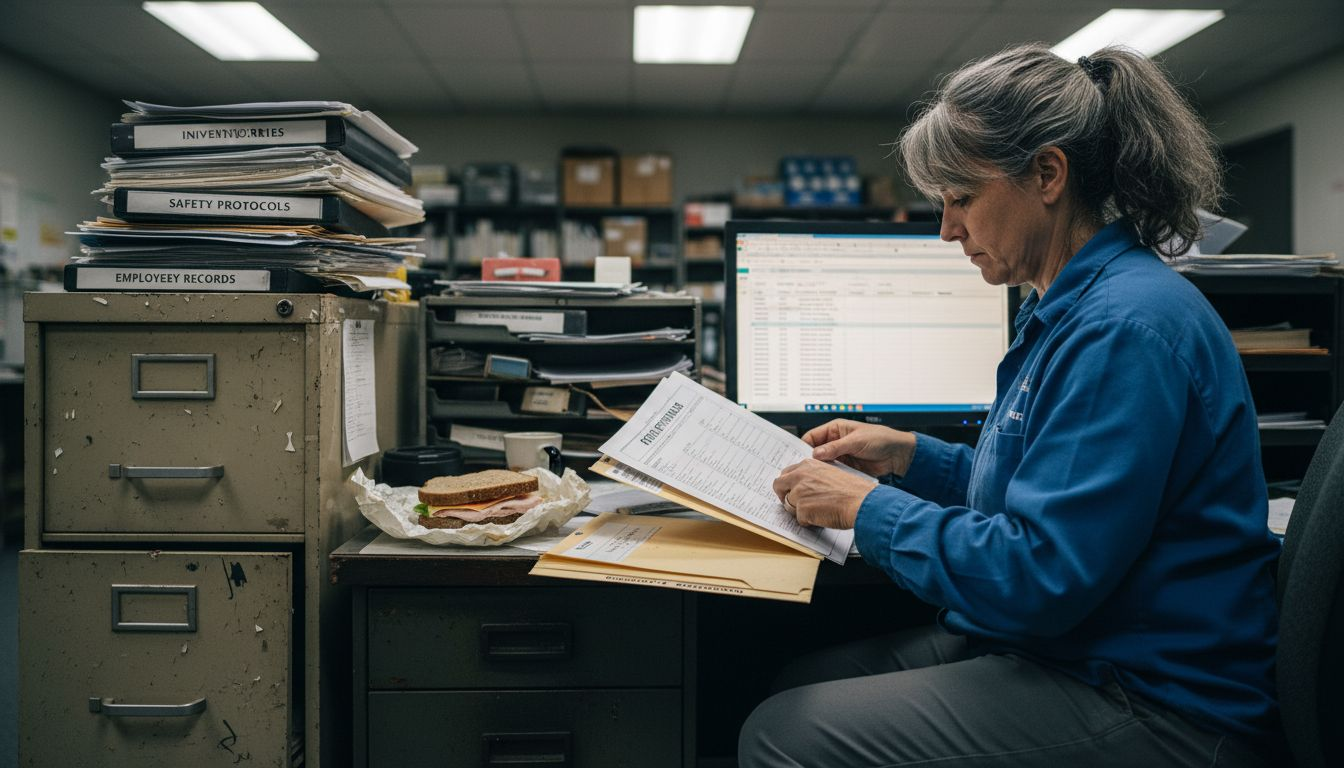
Digital recordkeeping systems address these vulnerabilities directly. OSHA’s updated recordkeeping directive emphasizes the benefits of transitioning to digital records, reflecting industry movement toward safer, more accessible documentation methods. Digital systems provide redundancy through cloud backup, allowing you to recover records even if your office suffers damage. Search capabilities matter too. Finding training records for a specific operator in a paper file system takes time and introduces opportunities for error. Digital platforms let you pull up any operator’s complete certification history in seconds. During an OSHA inspection, this speed demonstrates organization and preparedness. Inspectors notice when you hand them organized digital documentation versus when you fumble through filing cabinets. The difference influences how thoroughly they scrutinize other aspects of your safety program.
Yet paper records aren’t obsolete. Many digital systems still incorporate paper elements like sign-in sheets and course outlines as supporting documentation. The practical reality is that a hybrid approach often works best for most warehouse operations. Digital recordkeeping provides the primary storage and backup mechanism, while paper sign-in sheets and certificates create on-site verification during training. This combination gives you the accessibility and security of digital systems plus the immediate proof of attendance that paper provides. Your operator completes a forklift training class, signs the paper attendance sheet, and the trainer inputs the certification into your digital system that same day. You keep both records. If the digital system experiences a temporary outage, the paper records confirm training occurred. If paper records get damaged, your digital backup ensures nothing is permanently lost.
The following table summarizes the main risks and benefits of digital versus paper forklift training records:
| Factor | Digital Records | Paper Records |
|---|---|---|
| Accessibility | Immediate, searchable, remote access | On-site, manual search required |
| Backup/Security | Cloud backup, disaster recovery | Vulnerable to loss, damage, or theft |
| Audit Response | Rapid report generation | Time-consuming retrieval |
| Usability | Automates reminders and tracking | Prone to errors, manual updates |
The comparison really comes down to organizational maturity and risk tolerance. Small operations with five or six operators might manage perfectly fine with organized paper files and manual tracking. As you grow to twenty, thirty, or fifty certified operators across multiple shifts, paper recordkeeping becomes impractical. Tracking refresher training dates, managing equipment specific certifications, and generating reports for OSHA requests demand digital capability. Many warehouse management software platforms now include training documentation features designed specifically for compliance. These systems automate expiration reminders, flag operators approaching refresher deadlines, and generate audit reports with a few clicks. The investment in digital systems typically pays for itself through reduced administrative time alone, before considering the compliance protection benefits. Your recordkeeping system directly affects how efficiently your training program operates. A good system removes friction and maintains accuracy without requiring constant manual oversight.
Pro tip: Start with a hybrid approach: use a basic digital platform for primary storage while maintaining paper sign-in sheets, then migrate exclusively to digital once your system proves reliable and your staff adapts to the new process.
Roles And Responsibilities For Warehouse Managers
As a warehouse manager, you’re not just responsible for keeping forklifts running and deliveries moving. You’re legally accountable for ensuring every single operator receives proper training and that documentation proves it happened. This accountability is non-negotiable under OSHA regulations. The moment an operator gets injured or causes property damage, investigators look to you first. They want to see training records, certification dates, and evidence that you verified competency before putting someone behind the controls. Your role extends beyond signing off on training completion. You must actively manage the training program, coordinate with qualified trainers, track expiration dates, and maintain accessible records. This isn’t delegated responsibility that you hand off to someone else and forget about. Your signature or approval on training documentation means you’re attesting to its accuracy.
Your primary responsibility centers on coordinating with trainers to ensure compliance with OSHA’s training standards and maintaining meticulous documentation. This means vetting trainers before they instruct your operators. Ask about their credentials, experience with your specific equipment, and how they structure evaluations. Don’t assume someone who can operate a forklift can teach others to do it safely. A trainer needs knowledge of OSHA requirements, ability to assess operator competency, and skills to identify unsafe practices. Once training occurs, you’re responsible for verifying that documentation is complete and accurate. Check that training dates are recorded correctly, that the equipment type is specified, and that evaluation results are documented. Incomplete paperwork from a trainer who left your organization becomes your compliance problem, not theirs. You need systems that catch these gaps before OSHA does.
Your recordkeeping responsibility includes maintaining training accessibility for employees and OSHA upon request. This means operators should know where their training records are and be able to access them quickly. If someone gets injured and claims they never received training on that specific equipment, you need documentation ready immediately. OSHA inspectors will ask to see records for randomly selected operators. If you fumble around looking for files or discover gaps in documentation, expect the inspection to become more intensive. Your organized, accessible records demonstrate that you take compliance seriously. They also protect you legally. If an accident occurs and you can produce documentation showing the operator received proper training and evaluation, that record is valuable in potential liability disputes. Conversely, missing records suggest inadequate safety management. Beyond reactivity, your role includes proactive monitoring. Track when operators reach their refresher training deadlines. Flag operators whose certifications will expire in the next 30 days. Create a system that prevents someone from operating equipment on expired certification. Some warehouse managers use a simple spreadsheet with conditional formatting that highlights approaching expiration dates. Others use digital compliance platforms. The method matters less than consistency.
Your coordination role also includes providing operators with accessible, appropriate follow-up evaluations and refresher training. An operator who completed initial training two years ago needs refresher instruction before continuing to operate. You determine the frequency based on OSHA guidance and your company’s risk profile. New equipment arriving at your facility might require additional training beyond refresher requirements. You need to recognize these situations and coordinate training before operators use unfamiliar equipment. This proactive stance protects operators and your facility. It also demonstrates to OSHA that safety drives your decision-making, not convenience or cost-cutting. When inspectors see a warehouse manager who budgets for regular refresher training, maintains current certifications across the facility, and can articulate the reasoning behind training frequency, they recognize a program built on genuine safety commitment rather than regulatory compliance theater.
Pro tip: Assign one person as your compliance coordinator to own the training calendar, expiration tracking, and documentation management, then audit that person’s work quarterly to catch gaps before inspectors do.
Common Recordkeeping Mistakes To Avoid
Warehouse managers see training recordkeeping as a compliance checkbox. Complete the training, get the certificate signed, file it away. Done. This mindset creates vulnerability. The mistakes that sink compliance programs aren’t usually intentional violations. They’re oversights stemming from inadequate systems, unclear responsibility assignments, or simply not understanding what OSHA actually expects. A trainer leaves your organization and nobody maintains copies of the training records they conducted. An operator’s name gets spelled three different ways across various documents. Training dates get recorded in MMDDYYYY format on some forms and MMDDYY on others, creating confusion during audits. These seem minor until an OSHA investigator arrives and uses them as evidence of disorganized record management. The investigation widens. Your entire safety program gets scrutinized more carefully.
One of the most common mistakes is incomplete or missing documentation. Failing to retain records accurately undermines your compliance posture immediately. This includes missing trainee signatures, incorrect spelling of operator names, insufficient detail about topics covered, and absent evaluation results. A sign-in sheet that shows someone attended a forklift training class doesn’t constitute complete training documentation. You need the trainer’s name and credentials, the specific equipment types covered, the date of training, the evaluation method used, and proof that the person was deemed competent. If your documentation is missing any of these elements, you’ve created a gap. OSHA doesn’t care that the person actually received training if you can’t prove it with documentation. The burden falls on you to demonstrate compliance. Some warehouse managers have trainers complete abbreviated paperwork to save time. This backfires consistently. Spending an extra five minutes per operator on complete documentation prevents hours of problems later.
Another critical error is failing to maintain records after trainers or operators leave your organization. Documentation must persist beyond employment changes, yet many facilities lose records when trainers depart. You inherit liability for their training activities. If an operator trained by someone who left your company two years ago gets injured today, OSHA will ask to see that operator’s original training record. If it’s gone because the trainer took it or you discarded it, you’re in violation. Establish a system where all training records belong to your facility, not individual trainers. Create digital or paper copies and maintain them centrally. When a trainer leaves, you don’t lose documentation. When an operator is terminated or transfers, their records stay with you. Many small warehouse operations make the mistake of relying on a single person to track training. When that person leaves, institutional knowledge disappears. Critical expiration dates go unnoticed. Training deadlines pass. New managers don’t understand what certifications operators hold. Build redundancy into your recordkeeping system. Multiple people should be able to locate and understand your training records.
Premature record disposal represents another significant mistake. The five-year retention requirement runs from the end of the calendar year in which training occurred. An operator trained on January 15, 2020 must have documentation maintained through December 31, 2024. Many warehouse managers think the requirement ends on the anniversary date of training. It doesn’t. Calendar year determines retention period. Disposing of records before the calendar year ends exposes you to violations. Implement a simple calendar-based disposal schedule. Mark when records become eligible for purification. Maintain a retention log showing what was kept, what was destroyed, and when. If OSHA investigators ever question your recordkeeping practices, you can demonstrate systematic, compliant disposal rather than appearing to hide records. Additionally, avoid mixing up training information across forms or systems. Inconsistent formatting, varying name spellings, and unclear date conventions create confusion during audits. Use standardized templates for all training documentation. Require consistent data entry. Use dropdown menus in digital systems to eliminate spelling variations. When everything looks organized and consistent, auditors perceive competence and compliance. When records appear messy and inconsistent, inspectors investigate more thoroughly.
Pro tip: Create a quarterly compliance check where you pull random operator files and verify each one contains all required elements: signed trainer credentials, equipment type specifications, evaluation results, and correct retention dates before anything gets discarded.
Ensure Your Forklift Training Records Are Always Audit-Ready with Expert Support
Maintaining OSHA-compliant forklift training records is challenging yet critical to avoid costly penalties and liability risks. This article highlights the importance of accurate documentation, from detailed training dates and equipment types to trainer credentials and refresher schedules. If you struggle with incomplete files, lost paperwork, or tracking expiration dates, you are not alone. Many warehouse managers face these exact problems that can jeopardize safety and compliance.
Take control today by exploring comprehensive solutions at Forklift Certification and Forklift License archives on Forkliftacademy.com. Whether you need online training, onsite classes, or train-the-trainer kits, our programs are designed to simplify recordkeeping and ensure your operators meet all OSHA standards. Visit Forkliftacademy.com now to get started on building secure, organized, and easy-to-access forklift training records that protect your warehouse and empower your team. Don’t wait until an inspection—act now for peace of mind and compliance confidence.
Frequently Asked Questions
What are the key requirements for forklift training recordkeeping?
Forklift training recordkeeping must include operator names, training dates, equipment types, and trainer credentials. These records need to be maintained for at least five years from the end of the year in which training occurred.
Why is it important to keep accurate forklift training records?
Accurate forklift training records are crucial for demonstrating compliance with OSHA regulations. They provide verifiable proof of training in case of an inspection or an incident, which can protect against legal liabilities and penalties.
What documentation is required for forklift training under OSHA regulations?
OSHA requires records that consist of sign-in sheets, course outlines, trainer qualifications, and certification documentation. All records should clearly show the date of training, the specific equipment covered, and the proof of the trainee’s evaluation.
How often should forklift operators receive refresher training?
The frequency of refresher training for forklift operators depends on your organization’s policies and the specific risks associated with equipment use. However, OSHA recommends providing refresher training whenever there are significant changes in equipment or if an operator has been involved in an incident.
Recommended
- Forklift Trainer Responsibilities: Complete Guide – Top Osha Forklift Certification
- Complete Guide to OSHA Compliance for Forklift Safety – Top Osha Forklift Certification
- Forklift Certification for Businesses: Ensuring OSHA Compliance – Top Osha Forklift Certification
- Forklift Training Compliance Guide: Complete Overview – Top Osha Forklift Certification