
Finding the right person to serve as your forklift trainer can determine whether your warehouse meets OSHA compliance or faces preventable safety risks. For American warehouse managers, this role goes far beyond knowing how to operate equipment. A qualified trainer must demonstrate both practical skills and strong instructional ability, ensuring operators are evaluated for true competency in your specific environment. This guide breaks down the core responsibilities and required skills for effective forklift trainers so you can confidently select and support the right leaders for your team.
Table of Contents
- Defining Forklift Trainer Roles And Skills
- Types Of Forklift Trainer Certification
- Osha Requirements For Trainer Qualification
- Core Training And Evaluation Duties
- Managing Compliance, Records, And Legal Risks
Key Takeaways
| Point | Details |
|---|---|
| Trainer Qualifications Matter | Forklift trainers must possess extensive knowledge and hands-on experience to ensure safe operation and effective instruction. |
| Certification Types Vary | Different certifications serve distinct roles; the Train-the-Trainer focuses on operator training, while the Certified Forklift Technician emphasizes maintenance. |
| Compliance Documentation is Essential | Maintaining thorough records of training and evaluations is crucial for meeting OSHA requirements and defending against legal risks. |
| Regular Refresher Training is Necessary | Schedule refresher training every three years and following significant operational changes to ensure ongoing operator competency. |
Defining Forklift Trainer Roles and Skills
A forklift trainer occupies a critical position in your warehouse safety structure. This person bridges the gap between regulatory requirements and practical operations on your dock. Unlike an operator who simply drives a forklift, a trainer carries the responsibility of certifying that new and existing operators meet competency standards. To fill this role effectively, warehouse managers should understand what separates a qualified trainer from someone who just knows how to operate equipment.
The core requirement for any forklift trainer is possessing the knowledge, training, and experience necessary to instruct others in both the theoretical and practical aspects of forklift operation. More specifically, trainers must demonstrate practical skills and judgment to safely operate equipment under actual workplace conditions. This experience serves as the foundation for everything they teach. A trainer with 10 years of dock experience brings credibility that translates directly into more effective instruction. That warehouse manager or senior operator needs to understand OSHA requirements, load capacity principles, visibility limitations, and how equipment behaves when operated incorrectly. They must also recognize hazards that operators might miss and correct unsafe behaviors before they become habits.
Beyond technical competency, trainers need a distinct set of instructional skills that many experienced operators lack. Teaching others requires patience, clear communication, and the ability to break down complex procedures into manageable steps. Your trainer must conduct classroom instruction that covers regulatory requirements and equipment fundamentals. They perform hands-on demonstrations in your actual warehouse environment, showing operators how loads behave on your specific ramps, how tight your dock turns are, and where visibility issues appear. Finally, they evaluate operators in real workplace conditions to determine if someone has genuinely achieved competency or simply passed a written test.
Consider your warehouse operations when identifying a trainer from within your team. Look for someone who already serves as a safety leader, asks questions about procedures, and takes pride in doing things correctly even when nobody is watching. They should be comfortable speaking to groups and genuinely interested in helping coworkers improve. Understanding what qualifications trainers need helps you identify the right internal candidate or know what credentials to require when hiring. Some warehouses discover that their best trainer is not their highest performer operator but rather someone with moderate skills who excels at explaining concepts and adapting instruction to different learning styles.
Pro tip: Assign your most safety-focused experienced operator as your primary trainer, then backup that person with a second trainer trained in the same methods so you maintain consistent instruction during vacations or staffing changes.
Types of Forklift Trainer Certification
Forklift trainer certifications come in several varieties, each designed to address specific roles and responsibilities within your warehouse safety program. Understanding the differences between these certifications helps you determine which credentials matter most for your operation and which trainers on your team should pursue them. Not every trainer certification carries the same weight or covers the same material, and some certifications open career pathways beyond just training operators.
The most common trainer credential is the Train-the-Trainer certification, which directly prepares individuals to instruct forklift operators in your workplace. These programs typically include both theoretical and practical components. You’ll find that train-the-trainer programs cover equipment classes 1 through 7 using materials aligned with OSHA and ANSI standards. The structure usually involves a self-paced online portion where trainers learn regulatory requirements, safety principles, and instructional methods. Then comes the hands-on training component, delivered in person, where your trainer demonstrates actual equipment operation and teaches evaluation techniques. Eligibility requirements are straightforward: participants must be at least 20 years old and able to operate forklifts themselves. This certification directly translates to your warehouse operations because graduates can immediately begin conducting classroom instruction, hands-on demonstrations, and competency evaluations for your operators.
Another certification path worth considering for certain roles is the Certified Forklift Technician (CFT) credential. While this certification focuses on maintenance, service, and repair rather than operator training, it addresses a different but equally important gap in warehouse operations. This pathway includes optional online training, online knowledge assessments, and hands-on performance evaluations. CFT-certified individuals possess essential skills for maintaining your fleet and troubleshooting equipment issues that operators report. Some warehouses benefit from having one trainer hold both the Train-the-Trainer and CFT credentials, creating someone who understands not only how operators should use equipment but also how that equipment functions mechanically. This knowledge helps trainers explain maintenance requirements to operators and recognize when equipment failures occur due to misuse rather than mechanical failure.
When evaluating trainer certification options for your warehouse, consider what your current safety program needs most. Does your primary concern involve bringing operators up to OSHA compliance standards? The Train-the-Trainer route serves that need directly. Do you struggle with equipment downtime and want trainers who understand mechanical operation deeply? The CFT credential provides that foundation. Many mid-sized warehouses discover that pursuing Train-the-Trainer certification for their primary safety person, combined with understanding how to become a forklift trainer in the first place, creates a sustainable training structure that evolves with your operation’s needs.
Here’s a comparison of the main forklift trainer certifications and their applications:
| Certification Type | Main Focus | Eligibility | Key Benefit |
|---|---|---|---|
| Train-the-Trainer | Operator instruction & OSHA | 20+ years old, operator skill | Enables in-house operator certification |
| Certified Forklift Tech | Maintenance, troubleshooting | Maint./repair experience | Reduces downtime, improves fleet safety |
Pro tip: Document which trainers hold which certifications and renewal dates on a single spreadsheet, then set calendar reminders three months before any certification expires so you maintain continuous OSHA-compliant training capacity without gaps.
OSHA Requirements for Trainer Qualification
OSHA does not prescribe a single certification standard that all forklift trainers must hold, but instead establishes baseline competency requirements that trainers must meet. This distinction matters because it means your warehouse has flexibility in how you develop and credential your trainers, but zero flexibility in the knowledge and skills they must demonstrate. Understanding what OSHA actually requires helps you evaluate whether a trainer candidate possesses the necessary qualifications, regardless of where they received their credentials.
At its core, OSHA requires that anyone training forklift operators possess three critical capabilities. First, they must have the knowledge and comprehension to teach forklift operation safely. This goes beyond simply knowing how to drive a forklift yourself. Your trainer needs to understand load dynamics, stability principles, visibility limitations, and the regulatory landscape surrounding equipment operation. Second, trainers must have the physical ability to demonstrate proper equipment operation. They cannot merely lecture about safe procedures from the classroom; they must show operators how to execute techniques correctly in actual warehouse conditions. Third, trainers must demonstrate effective instructional ability. They need to assess whether operators truly understand the material and can apply it safely, not just whether they can recite facts. Training programs aligned with OSHA requirements prepare individuals with knowledge, physical ability, and comprehension to meet these standards consistently.
What makes this concrete in your warehouse is understanding the three-part training structure OSHA requires. Classroom instruction covers regulatory requirements, equipment specifications, load capacity principles, and safety procedures. Your trainer delivers this component and ensures operators can answer basic knowledge questions. Hands-on training demonstrates actual equipment operation in your specific warehouse environment. Your trainer shows how to position loads, navigate tight spaces on your dock, and handle the unique challenges your operation presents. Workplace evaluation puts operators in real scenarios with actual loads and equipment to confirm they can execute safe operation independently. Many warehouse managers discover that their best trainers are not necessarily their top equipment operators but rather those who excel at breaking down complex procedures and recognizing when an operator has achieved genuine competency versus simply completing required hours.
OSHA compliance for trainer qualification also requires documentation. You must maintain training records showing which individuals delivered instruction, when training occurred, which operators received training, and confirmation that evaluation occurred. This paper trail protects your warehouse by demonstrating good faith compliance efforts if an accident occurs and also helps you identify which operators need refresher training or recertification. Some warehouse managers use this documentation to spot patterns, such as noticing that operators trained by certain individuals have fewer incidents, which indicates superior training effectiveness.
Pro tip: Create a trainer competency checklist covering knowledge assessment, hands-on demonstration ability, and instructional effectiveness, then use it to evaluate trainer candidates before assigning them to conduct formal operator training.
Core Training and Evaluation Duties
Forklift trainer responsibilities center on three distinct but interconnected activities that together ensure operators can perform their jobs safely. These duties form the backbone of OSHA-compliant training, and understanding each one helps warehouse managers hold trainers accountable while also recognizing the work involved in doing this role well. Your trainer cannot skip any of these components or shortcut the process without compromising both safety and regulatory compliance.
The first core duty is delivering formal classroom instruction. This is where your trainer teaches the foundational knowledge operators need before ever touching a forklift. The classroom component covers operating instructions specific to the equipment your warehouse uses, regulatory requirements and industry standards, load capacity and stability principles, and hazard recognition in your warehouse environment. Your trainer must ensure operators understand these concepts, not just sit through a presentation. This means asking questions to confirm comprehension, correcting misconceptions immediately, and documenting attendance. The classroom portion typically spans several hours and provides the theoretical foundation for everything that follows. Many trainers make the mistake of rushing this phase, assuming operators will learn the important details during hands-on training. That approach backfires because operators without solid foundational knowledge often develop bad habits that are harder to correct later.
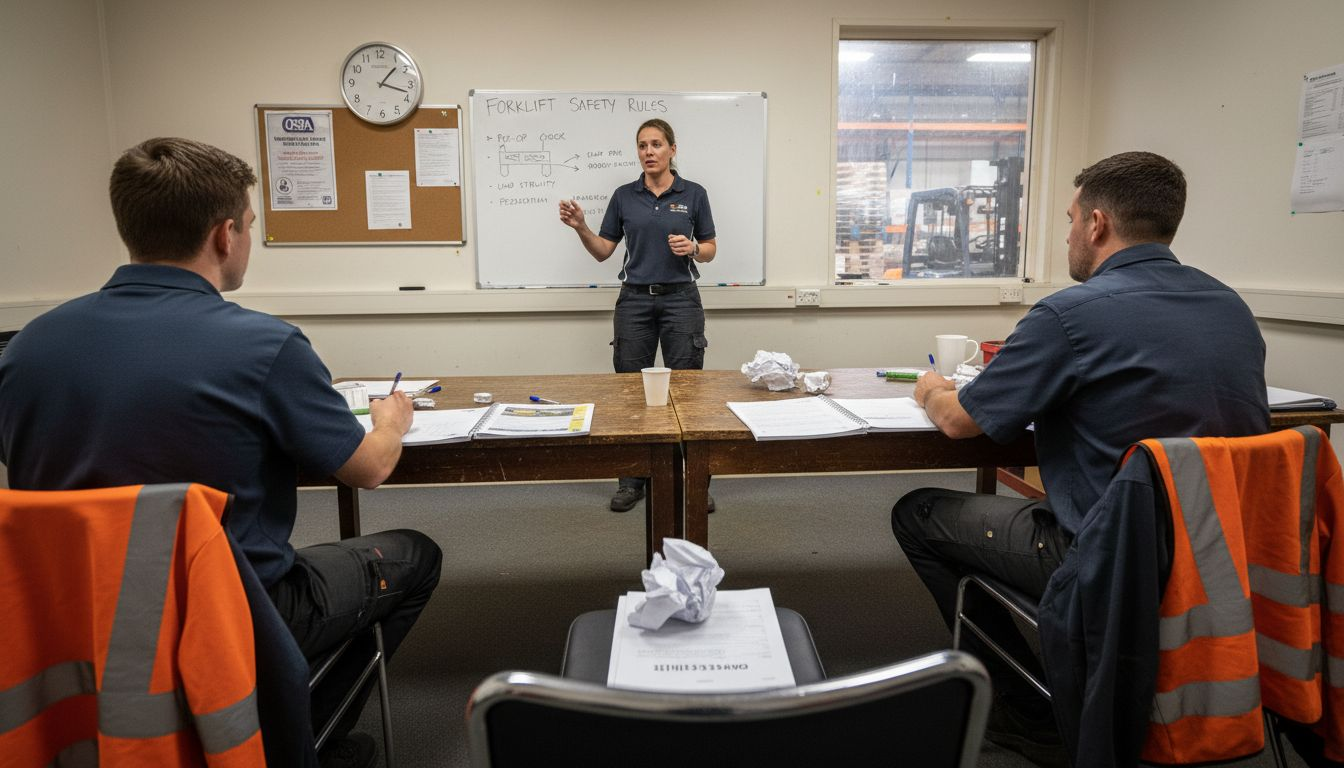
The second duty involves conducting practical hands-on training in your specific warehouse. Trainers must deliver site-specific hands-on training that supplements any external classroom training your operators may have completed elsewhere. This is critical because every warehouse has unique layouts, floor surfaces, load types, and operational challenges. An operator certified in a classroom might not understand how your specific ramps affect load stability or where blind spots exist at your dock doors. Your trainer demonstrates proper techniques using your equipment, in your warehouse, with your actual loads. They show operators how to approach tight corners in your aisles, how to maneuver around your specific obstacles, and how to recognize and respond to hazards unique to your operation. This hands-on phase builds confidence and muscle memory while allowing trainers to observe operators attempting techniques and correct errors before they become dangerous habits.
The third core duty is evaluating operator competency through workplace observation. This is where your trainer confirms that an operator can actually do the job safely, not just that they attended training. Evaluation means watching operators perform typical tasks in their regular work environment with actual loads and equipment. Your trainer observes how they position themselves, handle loads, navigate tight spaces, and respond to unexpected situations. They assess whether operators demonstrate the judgment and awareness needed to operate safely without supervision. Documentation of this evaluation is mandatory. Your records must show which trainer conducted evaluation, what specific tasks the operator demonstrated, the date of evaluation, and confirmation that the operator met competency standards. This creates the paper trail that proves OSHA-compliant training occurred.
One responsibility that often gets overlooked is refresher training and recertification. Your trainer must document when operators received initial training and then schedule refresher training every three years or whenever you introduce new equipment, modify warehouse layouts, or when operators demonstrate unsafe behavior. This ongoing responsibility prevents the skill decay that occurs when operators work safely for months and gradually develop shortcuts or bad habits. Some trainers view refresher training as repeating the same material. The better approach treats refresher training as an opportunity to assess current practices, update operators on any changes to procedures or equipment, and reinforce safety culture.
Pro tip: Create a simple one-page training evaluation form your trainer completes for each operator, listing specific tasks observed, safety behaviors demonstrated, and any areas needing improvement, then keep these forms organized by operator name and date so you have concrete documentation of training effectiveness.
Managing Compliance, Records, and Legal Risks
Documentation separates warehouses that can prove OSHA compliance from those facing citations and penalties when accidents occur. Your trainer’s responsibilities extend beyond delivering instruction to creating a detailed record trail that demonstrates your company took training seriously. This paper trail becomes invaluable if an incident happens, showing regulators and legal teams that your warehouse implemented proper training procedures. Without solid documentation, even excellent training efforts count for little in the eyes of OSHA or a courtroom.
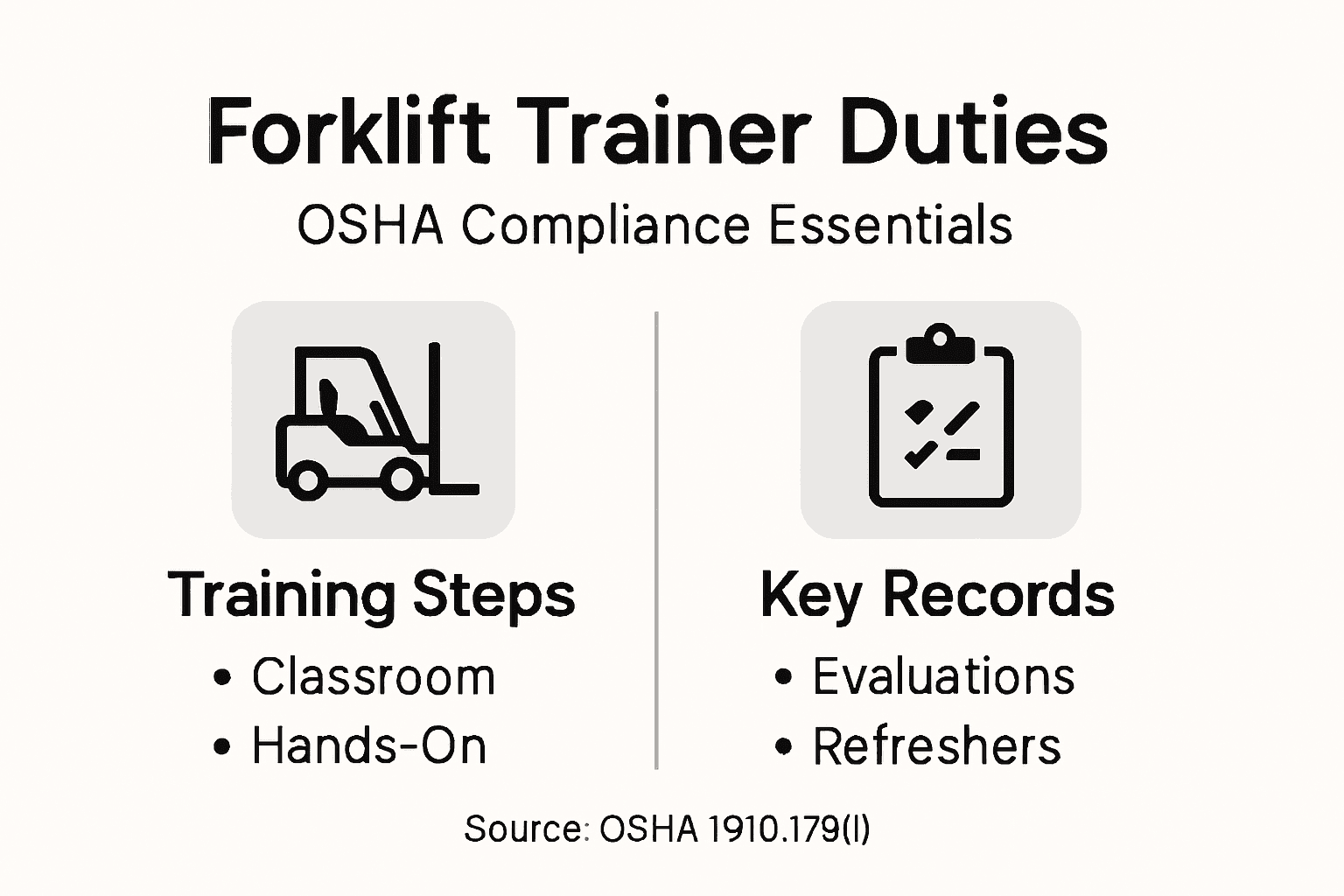
Your trainer must document specific information for every operator trained. This includes the operator’s name, date of training, date of evaluation, the name and credentials of the trainer who conducted instruction, and confirmation that the operator met competency standards. Employers must maintain records of forklift training and evaluations including operator names, training dates, evaluation dates, and trainer identities to comply with OSHA requirements. The documentation should specify what type of equipment the operator trained on and note any special conditions such as load types unique to your operation. If an operator received training from a previous employer, that training may count toward compliance only if it was relevant to your operation and the operator has been evaluated within the past three years by someone at your facility. This distinction matters because you remain liable for operator competency regardless of where they trained previously.
Record retention requirements vary, but the safest approach is maintaining training documentation for at least five years. This timeline aligns with typical statute of limitations for workplace injury litigation. Your records should include the original training documentation plus any refresher training records, evaluation notes, and any corrective training provided after unsafe behavior was observed. Many warehouse managers store these records in a centralized location, either physical files organized by operator name or a digital database that allows quick retrieval by trainee, trainer, or date. The key is ensuring records are accessible if OSHA requests them during an inspection or if you need to defend your training practices after an incident.
Below is a summary of essential forklift trainer documentation and its compliance value:
| Documentation Type | Required Details | Compliance Purpose |
|---|---|---|
| Training Records | Operator/trainer names, dates, topics | Demonstrate OSHA adherence |
| Evaluation Forms | Tasks observed, standards met | Prove competency verified |
| Refresher Logs | Recertification dates, updates | Track ongoing compliance |
Refresher training schedules create an ongoing compliance obligation for trainers. Operators require refresher training every three years at minimum, but your trainer should also schedule refresher training whenever you introduce new equipment, modify warehouse layouts significantly, or when you observe unsafe behavior from any operator. This creates a dynamic compliance system rather than a one-time training event. Your trainer documents each refresher session just as thoroughly as initial training, creating an updated record showing the operator remains current. Some warehouses use their trainer to conduct brief toolbox talks about specific hazards quarterly, which supplement but do not replace formal refresher training.
The legal risk dimension of documentation cannot be overstated. If your warehouse experiences a forklift incident, OSHA will request training records as part of their investigation. If those records show your trainer delivered classroom instruction, conducted hands-on training, and completed a competency evaluation, your company demonstrates compliance with regulatory requirements. Conversely, if records show minimal training, gaps in evaluation, or no documented refresher training, regulators interpret that as negligence. In litigation following an accident, opposing counsel will argue that inadequate training caused the incident. Your trainer’s documentation either supports or undermines your defense. Some warehouse managers discover too late that their trainer kept minimal records, making it impossible to prove training actually occurred.
Pro tip: Implement a simple spreadsheet listing all operators, their initial training date, their most recent evaluation date, and their next refresher training due date, then update it quarterly so your trainer knows exactly which operators need recertification without searching through files.
Strengthen Your Forklift Trainer Program for OSHA Success
Ensuring OSHA compliance starts with empowering the right individuals to become exceptional forklift trainers who handle all responsibilities meticulously. This means building skills in classroom instruction, hands-on training, and operator evaluation without missing a single detail in documentation. Many warehouse managers face challenges maintaining consistent training quality and keeping up with refresher requirements. By mastering these key areas, you prevent costly penalties, reduce workplace incidents, and build a culture of safety that lasts.
Take control of your warehouse safety now by exploring specialized resources in our Forklift Certification Archives – Top Osha Forklift Certification and stay updated on best practices through Forklift Safety Archives – Top Osha Forklift Certification. Visit Forkliftacademy.com today to access expert-led training courses, train-the-trainer kits, and certification programs designed to meet OSHA standards across the United States and Canada. Don’t wait until compliance gaps put your operation at risk. Start building a qualified and confident team of forklift trainers now.
Frequently Asked Questions
What are the main responsibilities of a forklift trainer?
A forklift trainer is responsible for delivering classroom instruction, conducting hands-on training, and evaluating operator competency in compliance with OSHA standards. They ensure that operators understand safety protocols, equipment operation, and hazard recognition specific to the warehouse environment.
What qualifications should a forklift trainer have?
A qualified forklift trainer should possess extensive knowledge of forklift operation, safety regulations, and instructional skills. They need to have the physical ability to demonstrate proper techniques and the capability to assess operator competence effectively.
How can I ensure my forklift training is OSHA compliant?
To ensure OSHA compliance, maintain thorough documentation of training records, evaluations, and refresher sessions. Your trainers should cover all required topics: regulatory requirements, equipment specifications, and conducting hands-on training in the actual warehouse environment.
How often should forklift operators undergo refresher training?
Forklift operators should undergo refresher training every three years as a minimum. Additionally, refresher training should be conducted whenever new equipment is introduced, significant warehouse layout changes occur, or when unsafe behavior is observed.
Recommended
- Forklift Trainer Certification Explained: OSHA Compliance Guide – Top Osha Forklift Certification
- What Is Train-the-Trainer Certification? Complete Overview – Top Osha Forklift Certification
- Understanding Why Become a Forklift Trainer Matters – Top Osha Forklift Certification
- What a Forklift Course Covers—OSHA Compliance and Safety – Top Osha Forklift Certification