
More than 11 percent of serious workplace injuries in American warehouses involve powered industrial trucks like forklifts. Across the United States, operators know that keeping certifications current isn’t just about meeting OSHA rules—it directly affects daily safety and job security. If you want simple, practical answers on forklift license renewal and its impact on legal compliance, operational skills, and risk reduction, this guide will give you the clarity you need.
Table of Contents
- What Is Forklift License Renewal?
- OSHA Validity Periods and Renewal Triggers
- Forklift License Renewal Process Steps
- Employer and Operator Responsibilities Explained
- Risks of Expired Forklift Certification
- Cost and Format Options for Renewal
Key Takeaways
| Point | Details |
|---|---|
| Forklift License Renewal is Mandatory | Operators must renew their certification every three years to ensure compliance with OSHA regulations and maintain workplace safety. |
| Training Requirements Include Theory and Practice | Renewal involves both classroom instruction and practical training, ensuring operators demonstrate continued competency. |
| Immediate Recertification Triggers Exist | Events like workplace accidents or unsafe observations may require operators to undergo immediate recertification to enhance safety. |
| Employers and Operators Share Responsibilities | Both parties must actively participate in training and compliance to foster a safe working environment and adhere to OSHA standards. |
What Is Forklift License Renewal?
Forklift license renewal is a critical safety process mandated by the Occupational Safety and Health Administration (OSHA) that requires forklift operators to complete recertification training approximately every three years. This mandatory procedure ensures operators maintain current knowledge of safety protocols, operational standards, and risk mitigation strategies when working with powerful industrial machinery.
The renewal process typically involves comprehensive training that covers key operational skills, safety guidelines, and updated OSHA regulations. Operators must complete both theoretical classroom instruction and hands-on practical training to demonstrate ongoing competency in forklift operation. This structured approach helps employers verify that their workforce remains current with industry safety standards and minimizes workplace accident risks.
During the renewal process, forklift operators will be evaluated on several critical components, including equipment inspection procedures, load handling techniques, workplace navigation skills, and understanding of potential hazard recognition. The training also addresses recent changes in safety protocols, equipment technologies, and regulatory requirements that may have emerged since their previous certification.
Pro tip: Always maintain your training documentation and schedule your renewal at least 30 days before your current certification expires to ensure continuous legal compliance and uninterrupted work eligibility.
OSHA Validity Periods and Renewal Triggers
OSHA regulations establish clear guidelines for forklift operator certification validity, mandating that certifications remain active for a standard three-year period. Operator evaluations must be completed periodically to maintain compliance with workplace safety standards and ensure continued operational competence.
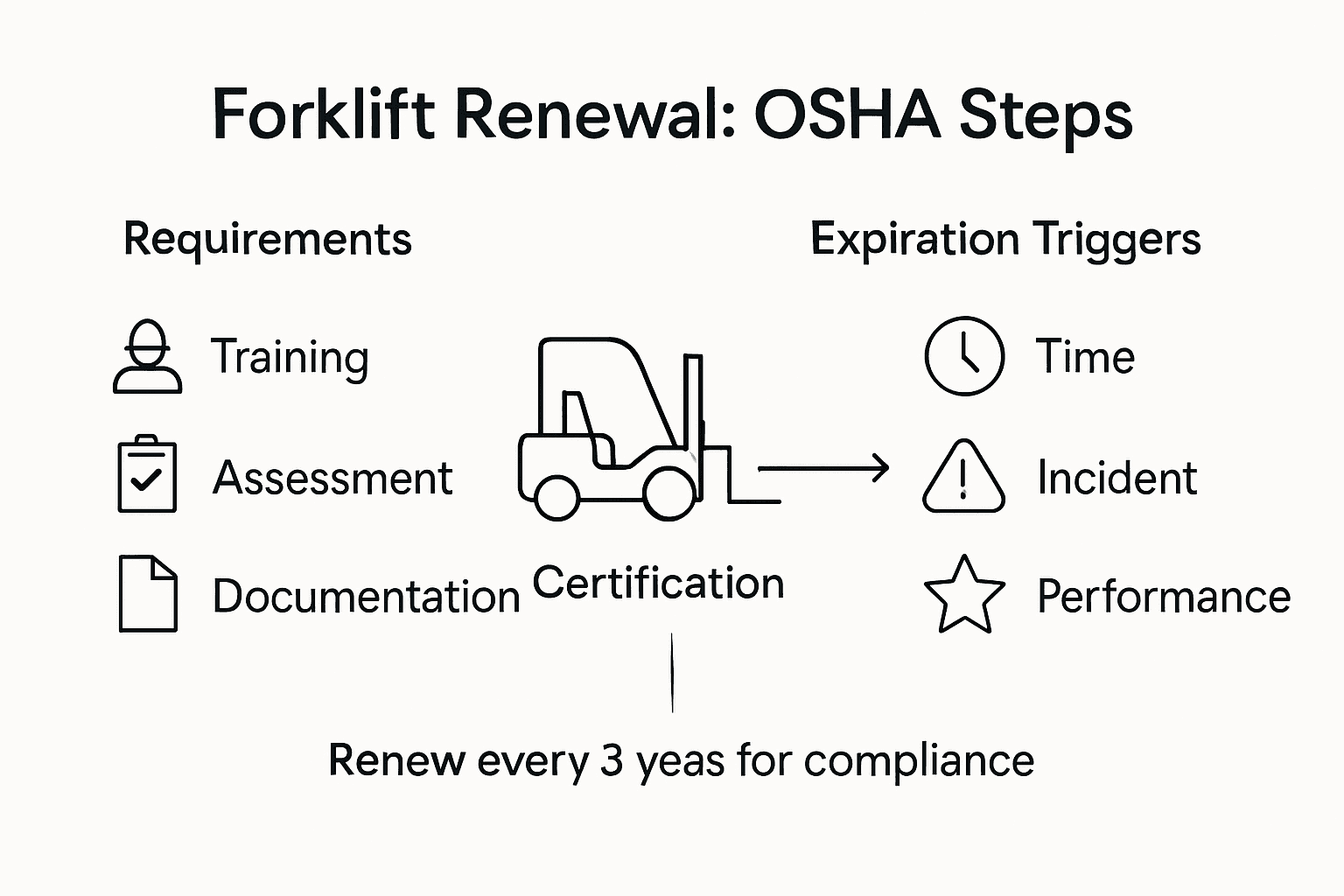
Renewal triggers are not limited to standard time-based expiration. Critical incidents that may necessitate immediate recertification include workplace accidents, near-miss events, unsafe operating observations, or significant changes in workplace equipment or operational environments. Employers are required to conduct comprehensive performance evaluations that assess an operator’s skills, knowledge, and adherence to safety protocols during these renewal processes.
The renewal process involves a multi-step assessment that goes beyond simple time tracking. Operators must demonstrate continued proficiency through written examinations and practical skills assessments, which evaluate their ability to safely navigate complex workplace scenarios, perform equipment inspections, and understand updated safety regulations. These rigorous evaluations ensure that forklift operators maintain the highest standards of workplace safety and operational excellence.
Pro tip: Maintain a detailed log of your training history and set calendar reminders at least 60 days before your certification expires to ensure seamless renewal without interruption to your work eligibility.
Here’s a quick look at common renewal triggers and their workplace impact:
| Renewal Trigger | Action Required | Workplace Impact |
|---|---|---|
| Standard 3-year expiration | Schedule routine renewal training | Maintains compliance and safety |
| Workplace accident | Immediate recertification review | Reduces future incident risk |
| Near-miss event | Additional skills evaluation | Reinforces safe practices |
| Unsafe operation observed | Targeted refresher training | Corrects unsafe behaviors quickly |
| Equipment/environment change | Full retraining on new procedures | Ensures updated skill mastery |
Forklift License Renewal Process Steps
Forklift license renewal involves a comprehensive multi-step process designed to ensure operators maintain the highest safety standards and operational competence. Operators must complete a structured training program that combines theoretical knowledge with practical skill assessments to successfully renew their certification.
The renewal process typically includes several critical stages. First, operators must enroll in an authorized OSHA-compliant refresher training course that covers updated safety regulations and operational techniques. This initial stage involves intensive classroom instruction where operators review current safety standards, equipment handling protocols, and potential workplace hazards. Following classroom training, operators progress to hands-on practical training, which requires demonstrating proficiency in actual forklift operation under professional supervision.
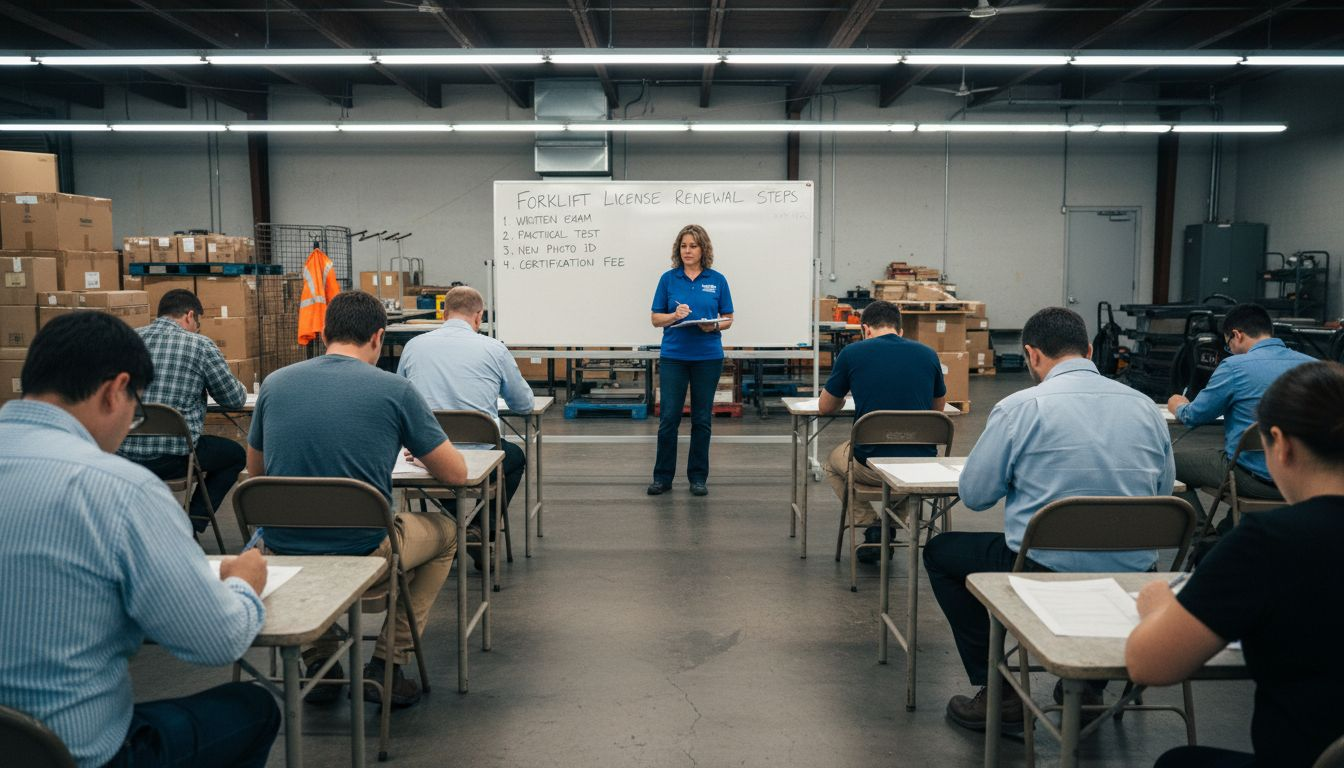
The final stages of renewal involve comprehensive evaluation and documentation. Operators must pass both written examinations and practical skills assessments that rigorously test their knowledge and operational capabilities. These assessments evaluate critical skills such as equipment inspection, load management, workplace navigation, and adherence to safety protocols. Employers are required to maintain detailed documentation of these evaluations, including performance records, test results, and certification credentials to ensure full compliance with OSHA regulations.
Pro tip: Maintain digital and physical copies of all your training documentation, and create a personal tracking system that alerts you 90 days before your current certification expires to streamline the renewal process.
Employer and Operator Responsibilities Explained
Workplace safety in forklift operations requires a collaborative approach with distinct responsibilities for both employers and operators. Employers bear the primary legal obligation to create and maintain a comprehensive safety training and compliance program that protects workers and meets stringent OSHA regulations.
Employers must implement a robust training framework that includes multiple critical components. This involves conducting initial and recurring training sessions, maintaining detailed documentation of operator certifications, performing regular skill evaluations, and ensuring workplace environments meet safety standards. Employers are responsible for providing appropriate training materials, qualified instructors, and practical assessment opportunities that thoroughly test an operator’s knowledge and operational skills.
Forklift operators carry equally important responsibilities in maintaining workplace safety. Operators must actively participate in all required training programs, demonstrate consistent adherence to safety protocols, and promptly report any equipment malfunctions, potential hazards, or workplace conditions that could compromise operational safety. Their personal commitment to following established procedures, maintaining equipment awareness, and continuously improving their operational skills is crucial in preventing workplace accidents and ensuring a safe working environment.
Pro tip: Create a shared digital documentation system that allows both employers and operators to track training progress, certification status, and safety compliance in real-time to enhance communication and accountability.
Risks of Expired Forklift Certification
Workplace safety depends critically on maintaining current forklift certification, as expired credentials can trigger catastrophic consequences for both operators and businesses. Operators using outdated certifications expose themselves and their employers to significant legal and operational risks that extend far beyond simple regulatory compliance.
The immediate and most severe risk of expired certification involves potential workplace accidents. Without current training, operators may lack critical knowledge about recent safety protocols, equipment updates, and hazard recognition techniques. This knowledge gap dramatically increases the probability of equipment mishandling, improper load management, and workplace incidents that could result in serious injuries, property damage, and potentially fatal accidents.
Legal and financial repercussions represent another profound risk of expired forklift certification. OSHA can impose substantial monetary penalties on companies employing uncertified operators, with fines potentially ranging from thousands to tens of thousands of dollars. Moreover, insurance companies may refuse to cover accidents involving improperly certified operators, leaving businesses exposed to potentially devastating litigation and financial liability. Companies could face immediate operational shutdowns, legal challenges, and irreparable damage to their professional reputation.
Pro tip: Implement an automated digital tracking system that sends certification expiration alerts to both operators and management at least 90 days before credentials lapse, ensuring continuous compliance and minimizing administrative oversight.
Cost and Format Options for Renewal
Forklift certification renewal offers multiple training formats designed to accommodate diverse learning preferences and operational requirements. Training costs and delivery methods vary widely, typically ranging from $90 to $200 depending on the specific program and regional providers.
Traditional in-person training remains the most comprehensive renewal option, combining classroom instruction with hands-on practical assessments. These programs provide direct interaction with certified instructors, allowing operators to receive immediate feedback and perform equipment-specific training. Classroom sessions typically cover updated safety regulations, equipment handling techniques, and potential workplace hazard scenarios, ensuring operators receive holistic and interactive learning experiences.
Alternative training formats have emerged to provide greater flexibility for working professionals. Online knowledge-based courses now offer initial theoretical components that operators can complete remotely, followed by in-person practical evaluations. These hybrid models reduce time away from work while maintaining rigorous OSHA compliance standards. Some providers also offer weekend and evening training sessions to accommodate varied work schedules, making certification renewal more accessible for operators across different industries.
Pro tip: Compare multiple training providers, verify their OSHA compliance credentials, and request detailed curriculum breakdowns to ensure you select a renewal program that meets both regulatory requirements and your specific workplace needs.
Compare in-person and online forklift renewal formats:
| Format Type | Scheduling Flexibility | Instructor Interaction | Typical Cost Range |
|---|---|---|---|
| In-person | Fixed class times | Direct, hands-on | $120–$200 |
| Online & Hybrid | Self-paced modules | Limited digital support | $90–$150 |
Stay Ahead with Reliable Forklift License Renewal Solutions
Maintaining OSHA compliance and avoiding costly downtime is essential when managing forklift license renewal. The article highlights key challenges like tracking certification expirations, completing refresher training, and navigating renewed safety standards. If you want to eliminate the stress of coordinating renewals while ensuring your team stays safe and certified, our comprehensive platform has you covered.
Explore flexible, OSHA-compliant forklift certification programs at Forkliftacademy.com. Whether you prefer online, onsite, or hybrid training formats, discover tailored solutions that simplify renewal and keep your workforce ready and protected. Learn more about how to renew your forklift license efficiently through our Forklift License Archives and broaden your operational expertise with our extensive resources in the Forklift Certification Archives. Take control of your safety and compliance today by visiting Forkliftacademy.com and schedule your renewal training now.
Frequently Asked Questions
What is forklift license renewal?
Forklift license renewal is a process mandated by OSHA that requires operators to undergo recertification training every three years to ensure they maintain up-to-date knowledge of safety protocols and operational standards.
How often do I need to renew my forklift license?
Forklift licenses typically need to be renewed every three years. However, additional recertification may be required if there are workplace accidents or significant changes in operational environment or equipment.
What does the forklift license renewal process involve?
The renewal process includes enrolling in an authorized training course, completing both theoretical classroom instruction and practical skills assessments, and passing evaluations to demonstrate ongoing competency in forklift operation.
What are the risks of having an expired forklift certification?
Expired forklift certifications can lead to increased risks of workplace accidents due to outdated knowledge, potential legal and financial penalties for employers, and reduced insurance coverage for incidents involving uncertified operators.
Recommended
- How to Renew Forklift License: Step-by-Step Guide – Top Osha Forklift Certification
- Forklift Refresher Courses: Complete Guide for 2025 – Top Osha Forklift Certification
- Complete Guide to OSHA Compliance for Forklift Safety – Top Osha Forklift Certification
- Forklift Trainer Responsibilities: Complete Guide – Top Osha Forklift Certification