
More than $35 million in OSHA fines hit American warehouses every year because of forklift violations. For warehouse safety managers, every overlooked certification or skipped equipment check can put both worker safety and business finances at serious risk. This overview gives you a clear look at exactly what causes these costly fines, how common compliance pitfalls impact American facilities, and practical steps to protect your team and your bottom line.
Table of Contents
- OSHA Forklift Regulations And Common Violations
- Types Of OSHA Forklift Fines And Penalties
- Key Compliance Requirements For Employers
- Financial Impact Of Non-Compliance Fines
- Proven Strategies To Avoid OSHA Forklift Fines
Key Takeaways
| Point | Details |
|---|---|
| OSHA Training Requirements | Maintain comprehensive operator training and certification records to ensure compliance and enhance safety. |
| Regular Equipment Inspections | Conduct daily equipment checks and maintain logs to minimize risks and avoid penalties. |
| Severe Financial Implications | Non-compliance can lead to significant financial penalties and indirect costs affecting business stability. |
| Proactive Safety Culture | Foster a safety-oriented environment that prioritizes continuous training and hazard reporting to prevent violations. |
OSHA Forklift Regulations and Common Violations
OSHA forklift regulations establish critical workplace safety standards that warehouse managers must meticulously follow to prevent dangerous accidents and substantial financial penalties. Forklift safety standards under 29 CFR 1910.178 outline comprehensive requirements for operator training, equipment maintenance, and operational protocols.
Common violations that trigger OSHA penalties include inadequate operator certification, insufficient equipment inspections, and improper operational practices. Warehouse safety managers frequently encounter violations related to operator training documentation, daily equipment checks, and failure to implement proper hazard control measures. Key areas of non-compliance often involve operators lacking current certification, trucks not receiving regular maintenance, and workplaces not establishing clear safety protocols for powered industrial truck operations.
The OSHA enforcement process involves detailed workplace inspections where compliance officers systematically review training records, equipment conditions, and operational procedures. Penalties for violations can range from $14,502 for serious infractions to $145,027 for repeated or willful non-compliance. These financial consequences underscore the critical importance of maintaining rigorous safety standards and comprehensive documentation for forklift operations.
Pro tip: Conduct monthly internal safety audits and maintain meticulous training and maintenance records to proactively prevent potential OSHA violations and reduce workplace risk.
Types of OSHA Forklift Fines and Penalties
OSHA has established a comprehensive penalty structure designed to enforce workplace safety standards across different violation categories. OSHA violation types range from minor infractions to serious and willful violations that carry significant financial consequences for businesses failing to maintain proper forklift safety protocols.
The primary categories of OSHA forklift violations include serious, other-than-serious, willful, and repeated violations. Serious violations occur when a hazard could potentially cause death or significant physical harm, with current penalties reaching up to $16,550 per violation. Other-than-serious violations address safety issues that might not directly cause serious injury but still represent workplace safety concerns, typically resulting in penalties around $14,502. The most severe category involves willful and repeated violations, which can trigger penalties up to $165,514 per violation, representing the most significant financial risk for repeated safety negligence.
Specific forklift-related violations that commonly trigger these penalties include inadequate operator training, failure to maintain equipment, lack of proper inspection records, and non-compliance with safety protocols. Employers can face additional financial penalties for failure to correct identified hazards within prescribed timeframes, with daily penalties accruing until the violation is properly addressed. The escalating fine structure is designed to compel businesses to prioritize workplace safety and proactively address potential hazards before they result in accidents or injuries.
Pro tip: Develop a comprehensive safety documentation system that tracks all forklift training, maintenance, and inspection records to demonstrate proactive compliance and minimize potential OSHA penalty risks.
Key Compliance Requirements for Employers
Employers must navigate a complex set of OSHA requirements to ensure comprehensive forklift safety and operational compliance. Forklift training programs require a systematic approach that combines formal instruction, practical demonstrations, and worksite-specific evaluations before operators can independently manage powered industrial trucks.
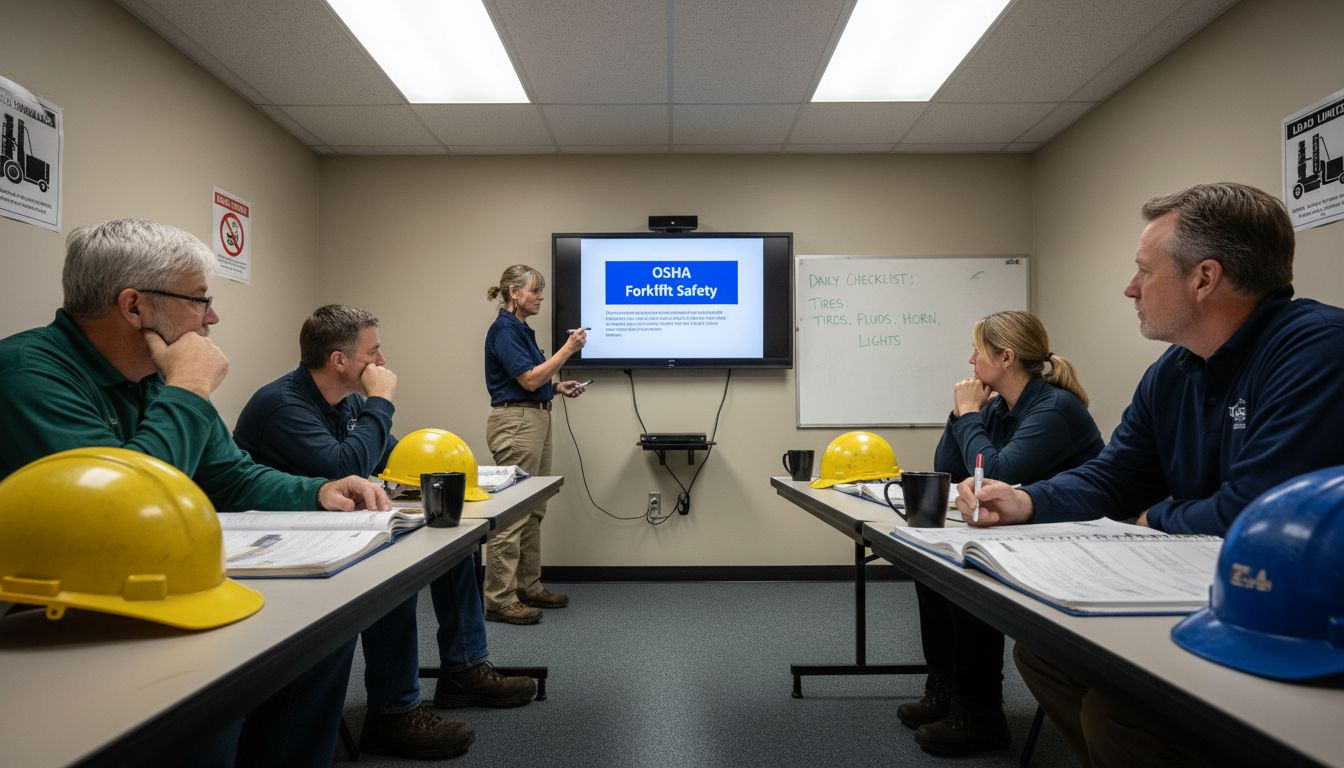
The core compliance requirements encompass several critical elements. Operator Training must include both classroom-based theoretical instruction and hands-on practical training specific to the workplace environment. Employers must develop documented training programs that cover equipment-specific operations, workplace hazards, and safety protocols. Certification and Documentation are mandatory, requiring employers to maintain detailed records of each operator’s training, including initial certification, performance evaluations, and periodic recertification. Operators must be formally evaluated every three years or after workplace incidents, near-misses, or observable performance issues that suggest potential safety concerns.
Additional compliance requirements extend beyond initial training to ongoing operational management. Employers must conduct daily pre-operation equipment inspections, maintain comprehensive maintenance logs, and establish clear safety protocols for load handling, workplace navigation, and potential hazard mitigation. This includes implementing written safety procedures, providing appropriate personal protective equipment, and creating a culture of continuous safety awareness. Workplace-specific risk assessments must be regularly updated to address changing environmental conditions, equipment modifications, and emerging operational challenges.
Summary of essential employer compliance actions for OSHA forklift safety:
| Compliance Requirement | Key Action | Employer Benefit |
|---|---|---|
| Formal Operator Training | Classroom & hands-on | Competent, safe operators |
| Certification Records | Maintain documentation | Pass OSHA audits easily |
| Equipment Inspections | Daily documented checks | Fewer maintenance issues |
| Hazard Controls | Update safety protocols | Reduced accident risk |
Pro tip: Create a centralized digital documentation system that tracks operator certifications, equipment maintenance records, and safety evaluations to streamline compliance management and demonstrate proactive safety commitment.
Financial Impact of Non-Compliance Fines
Forklift safety non-compliance can trigger devastating financial consequences that extend far beyond initial OSHA penalties. The total cost of workplace safety violations encompasses direct fines, indirect expenses, and long-term business risks that can potentially cripple a company’s financial stability and operational continuity.
Direct financial penalties represent the most immediate and quantifiable impact of non-compliance. Serious violations can result in fines up to $16,550 per incident, while willful or repeated violations can escalate to $165,514 per violation. These base penalties become exponentially more expensive when multiple citations are issued, creating a compounding financial burden. Beyond initial fines, employers face substantial indirect costs including increased workers’ compensation insurance premiums, potential legal expenses, operational disruptions, and potential civil litigation from workplace accidents.
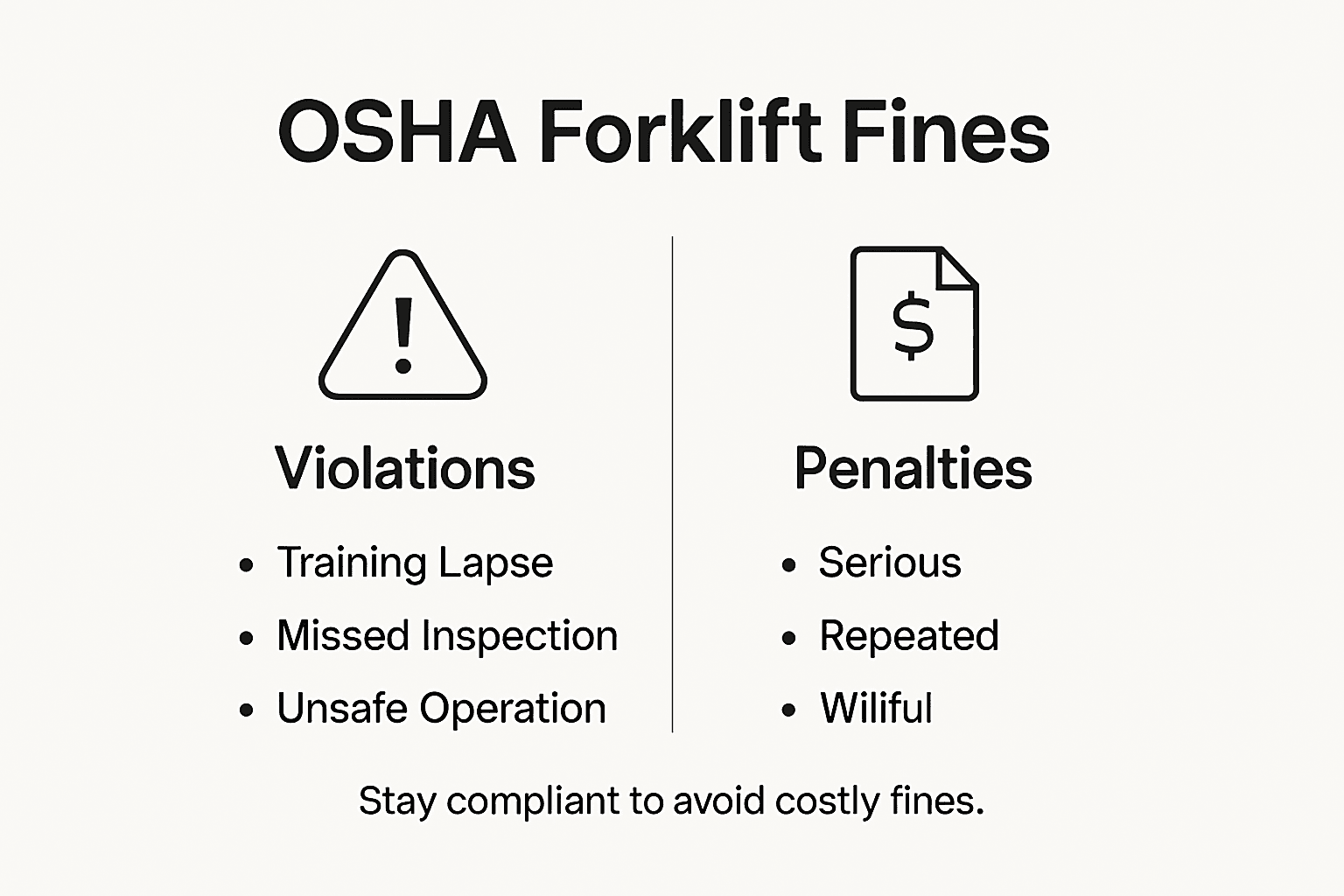
Here’s a comparison of OSHA forklift violation types and their financial impacts:
| Violation Category | Typical Cause | Maximum Fine (2024) | Business Impact |
|---|---|---|---|
| Serious | Major safety risk, injury potential | $16,550 per incident | Injury, insurance hikes |
| Other-than-Serious | Minor safety lapses | $14,502 per incident | Reputation risk, citations |
| Willful/Repeated | Intentional or recurring issue | $165,514 per incident | Legal action, shutdown risk |
| Failure to Abate | Uncorrected issues | $16,500 per day | Daily cost accruals |
The comprehensive financial risk extends into broader business impacts that can significantly damage an organization’s reputation and operational capacity. Non-compliance can trigger mandatory workplace shutdowns, contract cancellations, loss of business licenses, and potential criminal charges in cases of extreme negligence. Insurance providers may dramatically increase premiums or potentially cancel coverage altogether, creating a cascading effect of financial vulnerability. Small to medium-sized businesses are particularly susceptible, as these penalties can represent a substantial percentage of annual operational budgets, potentially threatening the entire organizational sustainability.
Pro tip: Allocate a dedicated budget for comprehensive safety training and compliance management to proactively mitigate potential financial risks associated with OSHA violations.
Proven Strategies to Avoid OSHA Forklift Fines
Warehouse safety managers can proactively minimize OSHA forklift fine risks by implementing a comprehensive compliance strategy. Strategic tactics for reducing workplace safety violations involve a multifaceted approach that addresses training, documentation, equipment maintenance, and continuous improvement.
Comprehensive Operator Training represents the foundational strategy for avoiding forklift-related violations. This requires developing robust training programs that go beyond basic certification, incorporating workplace-specific scenarios, equipment-specific instruction, and regular skills assessments. Employers must document all training sessions, maintain detailed records of each operator’s performance, and implement a systematic recertification process that includes periodic skill evaluations and hands-on practical assessments. Documentation and Record Keeping become critical, with meticulous tracking of training dates, performance evaluations, equipment maintenance logs, and incident reports serving as primary evidence of compliance during potential OSHA inspections.
Technological solutions and proactive safety management can significantly reduce non-compliance risks. Regular equipment inspections, preventative maintenance schedules, and implementing safety technologies that track operator performance and equipment condition provide additional layers of protection. This includes using digital inspection tools, maintaining real-time maintenance logs, and developing clear safety protocols that are consistently communicated and enforced across the entire workplace. Small to medium-sized businesses should particularly focus on creating a culture of safety that emphasizes continuous training, immediate reporting of potential hazards, and ongoing skill development for all forklift operators.
Pro tip: Develop a centralized digital safety management system that consolidates training records, equipment maintenance logs, and operator certifications to streamline compliance tracking and demonstrate proactive safety commitment.
Protect Your Workplace from Costly OSHA Forklift Fines Today
Workplace safety violations around forklift operations pose serious challenges that can lead to devastating financial penalties as detailed in the article “OSHA Forklift Fine Risks: Protecting Your Workplace.” Common pain points include insufficient operator training, lack of proper certification documentation, and inadequate equipment inspections—all of which increase your risk of OSHA fines and business interruptions. The article highlights terms like “willful violations,” “failure to abate,” and “comprehensive operator training” as critical concepts for safeguarding your operation. Facing these risks can be overwhelming, but you are not alone.
Take control now by partnering with Forkliftacademy.com, your expert resource for OSHA-compliant forklift training and certification across the United States and Canada. Our specialized programs provide online and onsite training, including comprehensive business solutions such as train-the-trainer kits and digital safety resources to help you maintain detailed documentation and foster a culture of safety. Don’t let avoidable violations threaten your business. Visit our Forklift Safety Archives to explore practical guidance and enroll today to achieve regulatory compliance and protect your workplace effectively. Act now to reduce risk, secure your workforce, and avoid costly OSHA penalties.
Frequently Asked Questions
What are the common OSHA forklift violations that can result in fines?
Common OSHA forklift violations include inadequate operator certification, insufficient equipment inspections, failure to maintain proper documentation, and non-compliance with safety protocols. These violations can lead to significant penalties.
How are OSHA fines for forklift violations structured?
OSHA fines for forklift violations can vary significantly, with serious violations costing up to $16,550, other-than-serious violations around $14,502, and willful or repeated violations reaching as high as $165,514. Daily penalties can also accumulate for unresolved issues.
What are the key compliance requirements for forklift operations under OSHA?
Employers must ensure comprehensive operator training, maintain certification records, conduct daily equipment inspections, and enforce safety protocols. Keeping meticulous documentation is essential for compliance and passing OSHA audits.
How can employers mitigate the financial impact of OSHA forklift violations?
Employers can mitigate financial impact by implementing rigorous training programs, maintaining thorough documentation of training and maintenance, conducting regular safety audits, and creating a culture of safety that emphasizes continual improvement.
Recommended
- Forklift Workplace Safety Explained: Complete Guide – Top Osha Forklift Certification
- Understanding the Importance of Workplace Safety – Top Osha Forklift Certification
- Forklift Safety: How to Prepare for OSHA Inspections – Top Osha Forklift Certification
- Forklift Safety Standards Explained: OSHA Rules and Compliance – Top Osha Forklift Certification