
Most American industrial workplaces rely on forklifts for moving heavy materials with speed and precision. With over 85 million forklifts estimated in operation worldwide, understanding the essentials of forklift operation can dramatically reduce workplace accidents and boost productivity. A deeper look into forklift mechanics, safety standards, and operator skills reveals why mastering these machines is crucial for anyone working in an American warehouse or construction environment.
Table of Contents
- Defining Forklift Operation And Its Core Principles
- Main Types Of Forklifts In Warehousing And Industry
- How Forklifts Work: Key Controls And Movements
- Operator Training, OSHA Compliance, And Certification Steps
- Safety Protocols And Common Risks In Forklift Use
Key Takeaways
| Point | Details |
|---|---|
| Forklift Operation Requires Training | Effective operation involves mastering complex mechanics, safety protocols, and situational awareness. Continuous training is crucial for maintaining skills and safety standards. |
| Understanding Forklift Types is Essential | Different forklift types are designed for specific applications; selecting the right type enhances operational efficiency and safety. |
| Safety Protocols are Critical | Rigorous adherence to safety measures helps mitigate risks associated with forklift operation, including accidents and equipment failures. |
| Certification and Compliance are Ongoing Processes | Operator training and recertification must be maintained to ensure competency and compliance with safety regulations. |
Defining Forklift Operation and Its Core Principles
Forklift operation represents a specialized skill involving the precise manipulation of industrial powered vehicles designed to lift, transport, and stack materials across workplace environments. These machines are engineered with complex mechanical systems that require professional training and meticulous understanding of operational protocols. Fundamental forklift mechanics involve mastering hydraulic systems, understanding load balance, and executing precise maneuverability techniques.
At its core, forklift operation demands comprehensive knowledge of equipment capabilities, safety regulations, and spatial awareness. Operators must comprehend the intricate relationship between vehicle design and load management, including understanding critical factors like weight distribution, lifting capacity, and stability dynamics. Safe equipment handling requires not just technical skill, but a holistic approach that prioritizes workplace safety and operational efficiency.
The primary components of effective forklift operation include understanding the machine’s structural elements like the mast, load carriage, and hydraulic lifting mechanisms. Operators must develop keen spatial perception, precise control techniques, and an ability to anticipate potential workplace hazards. Critical skills involve smooth acceleration, precise steering, balanced lifting, and situational awareness in dynamic industrial environments.
Pro Tip: Continuous Learning Strategy: Treat forklift operation as an ongoing skill development process by regularly reviewing safety protocols, participating in refresher training, and staying updated on the latest operational techniques and equipment innovations.
Main Types of Forklifts in Warehousing and Industry
Warehouse and industrial environments utilize diverse forklift types, each engineered for specific operational requirements and spatial configurations. Industrial forklift classifications demonstrate the complexity of material handling equipment, ranging from compact models for tight spaces to robust machines capable of managing substantial weight loads.
The primary forklift categories include counterbalance forklifts, which remain the most common type used across various industries. These versatile machines feature weight distribution mechanisms at the rear, enabling them to lift and transport materials without additional stabilizing equipment. Other critical variations include reach trucks designed for narrow warehouse aisles, electric pallet jacks for short-distance material movement, and rough terrain forklifts specifically engineered for outdoor construction and agricultural environments.
Here is a summary of the primary forklift types and their distinguishing business applications:
| Forklift Type | Key Application Context | Unique Feature |
|---|---|---|
| Counterbalance | General warehouses, factories | Rear weight distribution |
| Reach Truck | Narrow aisle storage | Extended reach capability |
| Electric Pallet Jack | Short-distance transport | Low-profile operation |
| Rough Terrain | Outdoor, uneven surfaces | Large, rugged tires |
Each forklift type presents unique operational characteristics and specialized functionality. Warehouse managers must carefully select equipment based on specific workplace requirements, considering factors like load capacity, maneuverability, power source, and environmental conditions. Considerations include maximum lifting height, battery or fuel type, wheel configuration, and the specific material handling challenges inherent to their particular industrial setting.
Pro Tip: Equipment Selection Strategy: Conduct a comprehensive workplace assessment before investing in forklifts, evaluating your precise material handling needs, spatial constraints, and operational environment to ensure optimal equipment matching.
How Forklifts Work: Key Controls and Movements
Forklift operational mechanics represent a sophisticated system of integrated controls and precision engineering designed to safely manipulate heavy materials in industrial environments. The core functionality revolves around three primary systems: power transmission, hydraulic lifting mechanisms, and steering controls. Operators must master the intricate relationship between these systems to ensure smooth, efficient, and safe material handling.
The hydraulic system serves as the forklift’s primary power translation mechanism, enabling precise vertical and horizontal load movement. Typically, operators control lifting functions through strategically positioned levers that manage mast elevation, forward and backward tilt, and side-to-side positioning of the load carriage. These hydraulic controls translate human input into mechanical motion, allowing for incremental adjustments in load positioning with remarkable accuracy.
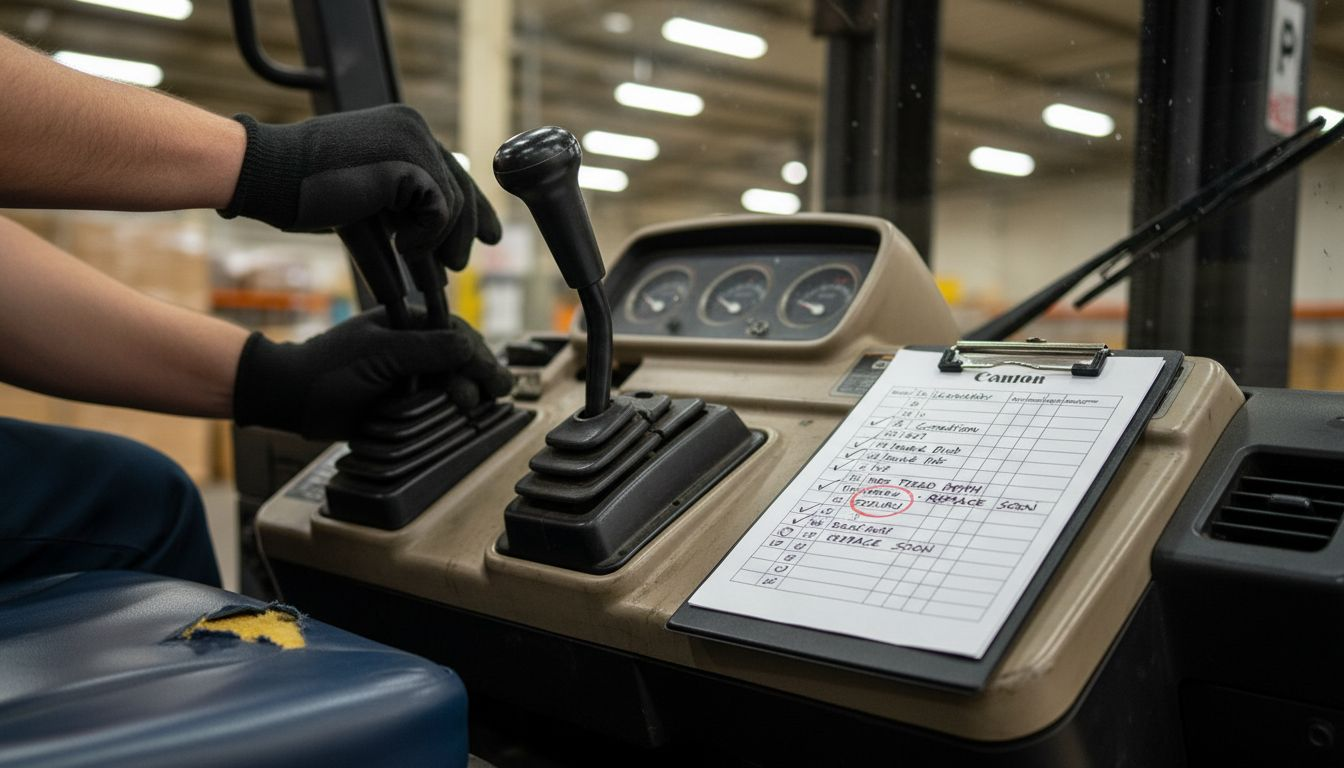
Workplace safety guidelines emphasize the critical importance of understanding each control’s specific function before operating the equipment. The primary control panel typically includes acceleration pedals, steering wheel, direction shift (forward/reverse), lifting controls, and emergency brake systems. Operators must develop muscle memory and spatial awareness to seamlessly integrate these controls, simultaneously managing vehicle movement, load stability, and surrounding environmental conditions.
Pro Tip: Control Mastery Strategy: Practice individual control movements in a safe, controlled environment before attempting complex load handling, focusing on developing smooth, precise mechanical coordination between hand, foot, and visual inputs.
Operator Training, OSHA Compliance, and Certification Steps
Forklift operator training requirements represent a comprehensive process designed to ensure workplace safety and operational competence. The certification journey involves multiple critical stages that transform novice operators into skilled professionals capable of handling complex material handling equipment safely and efficiently.
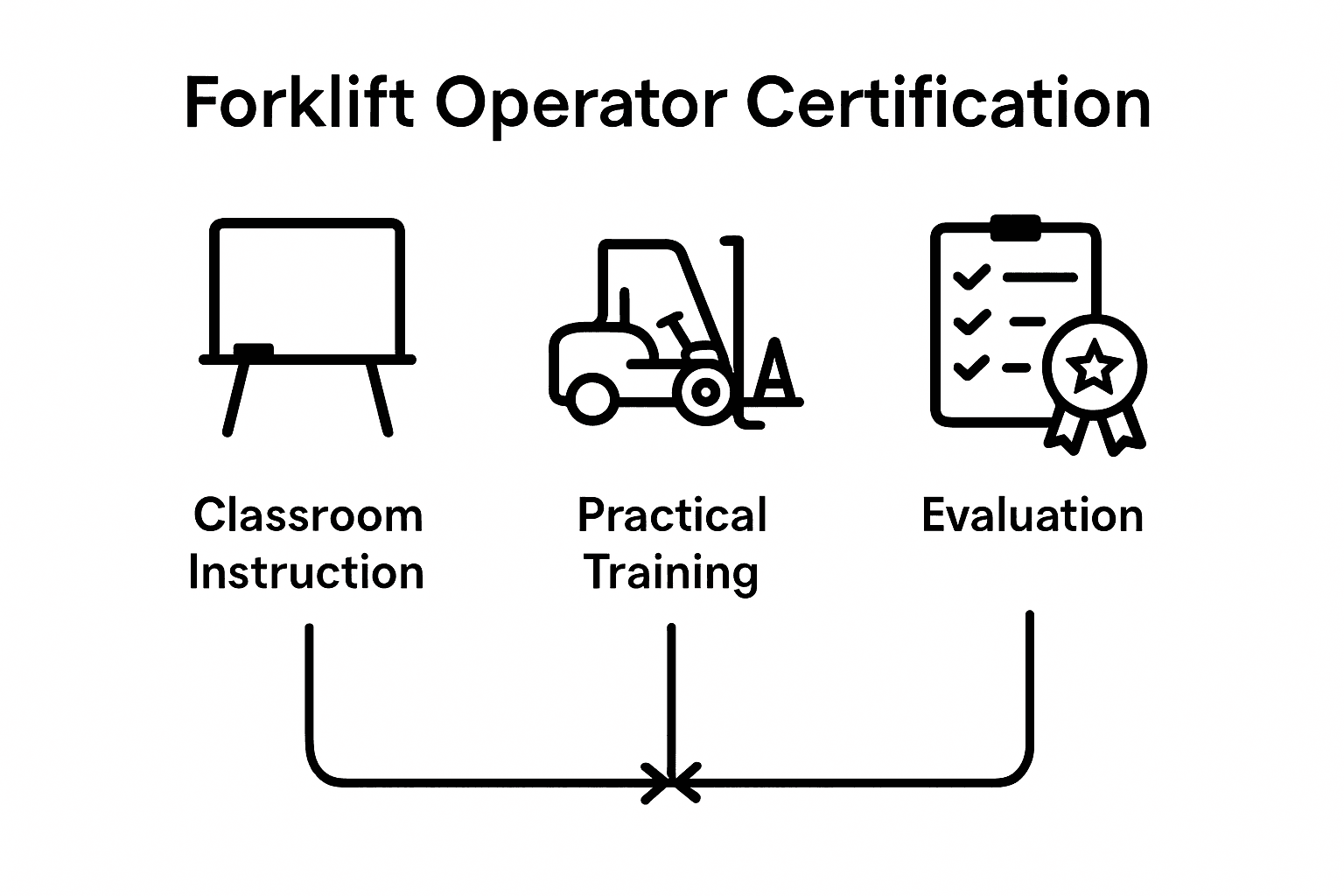
The training process typically encompasses three fundamental components: formal classroom instruction, practical hands-on training, and comprehensive performance evaluation. Employers must develop structured programs that cover theoretical knowledge of forklift mechanics, safety protocols, load handling techniques, and workplace hazard recognition. Operators must demonstrate proficiency in understanding equipment capabilities, understanding workplace regulations, and executing precise operational techniques under various challenging scenarios.
Workplace safety regulations mandate that certification is not a one-time event but an ongoing process of skill development and periodic reassessment. Operators are required to complete initial training, pass written and practical examinations, and undergo recertification every three years or after significant workplace incidents. The certification process includes comprehensive evaluations of an operator’s ability to perform critical tasks such as load management, spatial awareness, equipment inspection, and adherence to safety protocols.
Pro Tip: Continuous Learning Strategy: Treat forklift certification as a dynamic skill progression, maintaining a proactive approach to ongoing training, staying updated on the latest safety technologies and operational best practices.
Safety Protocols and Common Risks in Forklift Use
Workplace safety protocols for forklift operations represent a critical framework designed to prevent accidents and protect both operators and surrounding personnel. Understanding and implementing comprehensive safety measures requires a multifaceted approach that addresses equipment condition, operator competence, and environmental awareness.
The primary safety risks associated with forklift operations include potential tip-overs, load instability, pedestrian collisions, and mechanical equipment failures. Operators must conduct rigorous pre-operation equipment inspections, ensuring that all mechanical systems function correctly and that load capacities are strictly observed. Critical risk mitigation strategies involve maintaining clear visibility, establishing designated travel paths, implementing strict speed limits, and developing robust communication protocols between operators and ground personnel.
Industrial equipment safety guidelines emphasize the importance of comprehensive training programs that go beyond basic operational skills. Operators must develop situational awareness, understand load dynamics, recognize potential hazard zones, and master emergency response techniques. Potential risks include sudden load shifts, unexpected surface transitions, narrow workspace navigation, and complex maneuvering scenarios that require split-second decision making and precise control inputs.
Below is an overview of essential forklift safety protocols and their intended impact:
| Protocol | Purpose | Workplace Impact |
|---|---|---|
| Pre-use Equipment Inspections | Identify faults before use | Minimizes breakdowns, hazards |
| Designated Travel Paths | Organize machinery movement | Reduces collision risk |
| Load Capacity Monitoring | Prevent overload accidents | Maintains stability, safety |
| Clear Communication | Coordinate with personnel | Avoids pedestrian incidents |
Pro Tip: Situational Awareness Strategy: Treat every forklift operation as a dynamic risk environment, continuously scanning your surroundings, anticipating potential hazards, and maintaining a proactive safety mindset throughout your work shift.
Master Forklift Operation Safety with Confidence
Understanding the fundamentals of forklift operation and staying compliant with OSHA regulations are challenges every operator and employer face. This article highlights critical issues such as equipment control mastery, hazard recognition, and ongoing certification needs that ensure workplace safety and operational efficiency. If you want to overcome these challenges and reduce risks like load instability and tip-overs, it is vital to invest in comprehensive training tailored to real-world conditions and evolving safety standards.
Enhance your skills and knowledge by exploring our extensive resources at Forklift Safety Archives and secure your credentials through Forklift License Archives. These programs address the precise needs discussed here, including OSHA compliance, practical skill development, and continual learning strategies.
Take action now to protect yourself and your team with trusted, OSHA-compliant forklift training from Forkliftacademy.com. Whether you are seeking individual certification, onsite training solutions, or the latest in forklift safety education technology, our proven programs offer everything you need to operate safely and confidently every day.
Frequently Asked Questions
What are the basic safety protocols for forklift operation?
Forklift safety protocols include conducting pre-use equipment inspections, monitoring load capacities, establishing designated travel paths, and ensuring clear communication with personnel. These measures help minimize accidents and maintain a safe working environment.
What are the key components of effective forklift operation?
Effective forklift operation involves understanding the machine’s structural elements, such as the mast and hydraulic systems, and developing skills in load management, spatial awareness, and precise control techniques for maneuvering.
How often should forklift operators undergo certification and training?
Forklift operators typically require initial training and must be recertified every three years or after significant workplace incidents. Ongoing training and skill development are encouraged to maintain safety and compliance with regulations.
What are the risks associated with forklift operations?
Common risks in forklift operations include tip-overs, load instability, pedestrian collisions, and mechanical failures. Operators need to be aware of these risks and implement safety measures to mitigate them effectively.
Recommended
- Complete Guide to OSHA Compliance for Forklift Safety – Top Osha Forklift Certification
- What a Forklift Course Covers—OSHA Compliance and Safety – Top Osha Forklift Certification
- Forklift Workplace Safety Explained: Complete Guide – Top Osha Forklift Certification
- 7 Best Forklift Training Tips for Workplace Safety – Top Osha Forklift Certification